IBC Gimmicks: Can You Make Money Buying Cars?
By
/ Published:
/ Updated:
/ Read Time:
In Brief:
You cannot make money by buying a car — not even through the Infinite Banking Concept. What IBC actually does is preserve the opportunity cost of your capital: you keep the compounding growth on money you would otherwise spend outright or give to a bank in interest. That is a real financial advantage, but it is not profit from a purchase.
In This Article
- What the “make money buying cars” claim actually means
- Why the claim doesn’t hold up — and why that matters
- The opportunity cost of paying cash
- Three ways to finance a car and what each one costs you
- What IBC actually accomplishes in a car purchase
- Why this distinction matters for honest IBC practice
Where This Claim Comes From
The Infinite Banking Concept is not complicated. The core idea is straightforward: accumulate capital in an asset you control that is guaranteed to grow, then use leverage to finance the purchases of your life — capturing the opportunity cost that would otherwise go to a bank or be lost entirely.
Simple as it is, IBC requires a genuine paradigm shift. Because that shift is difficult to communicate, some practitioners and financial influencers resort to sensational claims. “Make money buying cars” is one of the most common — and one of the most damaging.
This is the second article in a series examining IBC misconceptions, misrepresentations, and marketing distortions. The goal is not to disparage IBC but to defend it — by replacing sales gimmicks with accurate explanations.
Claims that don’t pass the sniff test make a sound concept sound like a scam.
Why You Cannot Make Money Buying a Car
Buying a car costs money. That is true regardless of how you finance it.
The “make money” framing fails the same logic test as claiming you “saved money” at a sale because the price was marked down. Even if you bought something necessary at a lower price, the amount of capital you control has decreased. Spending is spending.
All capital carries an opportunity cost. When you spend cash, you lose not only that cash but every dollar it would have earned in the future. That cost is real whether or not it shows up on a receipt.
The “make money buying cars” claim is a distortion of something true: that by financing through your own banking function (storage, movement, and repayment of capital) rather than a commercial bank, you retain more of your money’s earning potential. That is meaningfully different from making money.
A Quick Note on “Recapturing Interest”
Before walking through the car example, it helps to clarify what “recapturing interest” actually means — because IBC gimmick claims often collapse two separate ideas.
When you borrow against your whole life policy’s cash value and repay with interest, two things happen:
- Direct return: A portion of the interest you pay flows back into your own banking system, increasing the capital you have available.
- Indirect return: Interest paid to the insurer contributes to the company’s profitability. As a participating policyholder, you share in that profitability through dividends — which purchase additional Paid-Up Additions (PUAs), increasing both death benefit and cash value.
Neither of these is “making money.” Both represent a more efficient use of capital compared to paying a commercial bank or spending cash outright. The distinction matters.
Three Ways to Finance a $30,000 Car
Consider a straightforward scenario: you need to buy a $30,000 car. You have the money saved and liquid. You have three options for how to pay.
Option 1: Pay Cash
The price of the car is $30,000, but that is not the total cost. The cost is what you gave up. If you do not buy the car, your $30,000 grows at a conservative 3% annual rate:
| Timeline | Value | Price of Car | Cost of Financing |
|---|---|---|---|
| 5 years | $34,800 | $30,000 | $4,800 |
| 30 years | $73,000 | $30,000 | $43,000 |
| 40 years | $98,000 | $30,000 | $68,000 |
| 50 years | $131,000 | $30,000 | $101,000 |
By paying cash, you eliminate the formal car debt — but you also eliminate every dollar that $30,000 would have compounded into. The true cost of paying cash is not $30,000. It is $30,000 plus $101,000 in surrendered future growth over 50 years.
Paying cash to avoid interest is like stepping over a $100 bill to pick up a nickel.
Option 2: Finance with a Commercial Bank
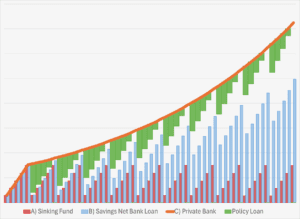
At 6% interest over 5 years, you would pay approximately $580/month — $34,800 total, with $4,800 going to interest.
Meanwhile, your original $30,000 remains in savings and grows to approximately $34,848 before taxes (roughly $33,832 after taxes). After the loan is paid off, that sum continues compounding.
The common instinct — pay cash to avoid $4,800 in bank interest — ignores that you sacrificed all the compounding growth on $30,000 to do it. You paid $4,800 to a bank, or you surrendered $101,000 in future growth. These are not equivalent choices.
Option 3: Finance Through Your Own Banking Function — IBC
With IBC, your $30,000 remains in your whole life policy earning dividends and accumulating cash value. You borrow against it and repay yourself under terms you control.
Nelson Nash called this being an “honest banker” — agreeing to hold yourself to terms at least as favorable as what a commercial bank would require, because your capital is worth no less than a bank’s. Anything less would be to short-change your own financial system.
Using the same $580/month payment structure as the commercial bank, your policy’s internal dynamics allow the loan to be paid off with the 57th payment. As an honest banker, you make the remaining 3 payments anyway — adding $1,740 back into your system. Your total capital in the policy at the end of 5 years: approximately $36,588.
In all three cases, $34,800 leaves your hands over 60 months. The difference is what remains on the other side — and who captured the benefit of your capital during that time.
What IBC Actually Accomplishes
Did you make money buying the car? No.
If you had not needed to buy a car at all, your capital position would be stronger. A purchase is still a purchase.
But compared to your alternatives, the IBC approach results in more capital available at the end of five years — and more at every point thereafter — because you retained the opportunity cost of that $30,000 rather than surrendering it to a commercial bank or spending it down entirely.
That is the honest claim. It is worth making. It does not require exaggeration.
It is the same behavior done from a position of control as the owner, and manager, and customer of our own banking system.
We all have to buy things. The question is which method of financing those purchases costs you the least over a lifetime. IBC answers that question well. It does not need the “make money buying cars” distortion to be compelling.
If you want to understand what IBC actually does — and what it doesn’t — book a free 30-minute clarity call with William Fullington at Reformed Finance.
Veritas non verbum venditoris

See What Greater Financial Control Could Look Like
Explore how the banking function operates in your household, business, or church—and whether the Infinite Banking Concept could help you retain more control of capital and cash flow.