Reformed Finance is More Than a Name
By
/ Published:
/ Updated:
/ Read Time:
In Brief:
Reformed Finance is named for two commitments. First, it is a confession of faith — we hold to the Reformed theological tradition, and we believe that biblical stewardship of money and resources is inseparable from a Christian worldview. Second, it is a conviction — that the way most Christians manage their finances needs to be reformed. Not tweaked. Reformed. Built on a old foundation, returning to older and more faithful principles of stewardship, family economy, and control of capital. That is what Reformed Finance is about. That is why we exist.
In This Article
- What the name “Reformed Finance” actually means — theologically and practically
- How conventional financial advice failed one military family
- How the Infinite Banking Concept (IBC) offers a better way
- Why IBC aligns with biblical stewardship and a Christian worldview
- What Reformed Finance exists to do for families and churches
What Does “Reformed” Mean in Reformed Finance?
The word “reformed” carries weight in two directions.
Theologically, it points to the Reformed tradition — the confessional Protestant heritage of Calvin, the Westminster Standards, and a covenantal view of life that refuses to separate Sunday from Monday. Biblical stewardship is not a budget tip. It is a duty. How we handle money, debt, capital, and provision for our families is a matter of faith, not just finance.
Practically, it is a call to action. The word “reform” means to return to a better, older foundation — to rebuild what has been corrupted. The Latin phrase Semper Reformanda — “always reforming” — captures it well. The conventional financial system has drifted far from principles of honest money, sound stewardship, and family independence. Reformed Finance exists to call families back.
Together, the name is both a confession and a conviction.
How Conventional Finance Failed Our Family
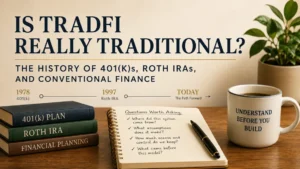
After graduating from college in 2005, I joined the military and married in 2006. Like most young adults, I followed the conventional financial playbook: get out of debt, fund your TSP (the 401(k) equivalent for federal employees and military members, managed by BlackRock), and start a Roth IRA.
The House We Were Told to Buy
At my first assignment, the advice from parents, in-laws, and senior officers was unanimous: buy a house. The logic was simple — my career field was likely to keep me at that base long-term, and if I did move, I could rent it out. My wife was working. We planned to have children. So we bought just above our budget to avoid having to upsize later.
Of course, in 2011, I received orders to move across the country.
We had purchased with a VA loan and no down payment — the “good deal” everyone recommends. The mortgage was high. We had no savings buffer built up yet. Market rent would barely cover the mortgage payment. My wife was losing her income during the transition. We had no good option. We had to short sell the house.
The Investment Account Nobody Was Watching
Around the same time, I went back to review my Roth IRA — the account I had been faithfully contributing to and trusting to grow. I had followed all the conventional advice: start young, let compounding work, trust the process.
After five years, my returns had not even kept pace with inflation. I later discovered my original agent had left the company. I had become an orphan account. No one was managing it. No one had told me.
From that point on, I knew something was fundamentally broken in the conventional financial system. It was not designed for the common family trying to build a future. I bore personal responsibility — I had been too trusting and had not done enough homework. But the system itself was not neutral. It was stacked.
How I Discovered the Infinite Banking Concept
I kept following conventional wisdom because I did not know there was another option. I maxed out my Roth IRA, contributed to TSP, and carried on.
Then, in 2023, I found IBC.
As I worked to get my first policy in place, I read everything I could. In addition to Nelson Nash’s foundational text, Becoming Your Own Banker, I read:
- How Privatized Banking Really Works by Robert Murphy and Carlos Lara
- Pirates of Manhattan I & II by Barry Dyke
- Economics in one lesson by Henry Hazlitt
- The Pension Idea by Paul Poirot
- The Fruits of Graft by Wayne Jett
- Blind Faith: Our Misplaced Trust in the Stock Market by Edward Winslow
- Unmasking the Sacred Lies by Paul Cleveland
- The Great Utopian Delusion by Clarence B. Carson and Paul A. Cleveland
(You can order these and more from my mentor, James Neathery at Banking With Life.)
What I Learned About the Financial System
These books opened my eyes to how the economic system actually functions — not how it is presented to consumers.
I had always known fiat currency was problematic. But I came to understand how fiat money and fractional reserve banking directly drive inflation — and how ordinary consumers taking loans for everyday needs are themselves fueling that inflation (Lara & Murphy).
I learned that 40% of the bull market of the 2010s was driven by large-scale stock buybacks — a form of stock manipulation that was illegal until 1982. Adjusting for this distortion, annualized market returns from 2007 to 2021 were approximately 3% (Dyke). I learned about the structural causes behind the Great Depression, the Tech Bubble, the Dot-Com Bubble, and the Housing Bubble (Jett, Dyke). I learned how the stories of Enron, WorldCom, and Michael Milken were not isolated failures but part of a broader pattern of mercantilist wealth transfer from ordinary families to financial elites (Winslow, Cleveland).
That reading was captivating. It was also angering.
Finding a Better Way
But after the darkness comes light. Post Tenebras Lux
In Nelson Nash’s work, I found the answer. Not a new answer — an older one. A more traditional way to save for emergencies and large expenses, to provide for my family when I could no longer work, and to take back control of the banking function (storage, movement, and repayment) in our lives.
We could reform our family’s personal finances to a purer, more solid foundation — not the shifting sand of Keynesian economics, but a system we could control.
I believed in this so completely that I began sharing IBC with anyone who would listen — friends, family, church members, coworkers. Like a new Christian in the “cage stage,” I had more energy for this than I knew what to do with. That passion eventually became a post-military calling. I continued studying and training, completed the NNI Practitioner program under the mentorship of James Neathery, and Reformed Finance was born.
Why IBC Aligns with Biblical Stewardship
The Infinite Banking Concept is not a product. It is a process — the process of taking control of the banking function in your own life using a properly structured, dividend-paying whole life insurance policy with a mutually owned company.
It aligns with a biblical view of stewardship for several reasons:
Control of capital. A Christian steward does not passively hand money to institutions and hope for good outcomes. IBC restores active management of your own capital — you know where it is, you control how it flows, and it is protected from the volatility of markets you cannot influence.
Generational thinking. Scripture calls families to think in terms of inheritance and legacy. IBC is built for the long horizon. Unlike conventional financial planning, based on a model accumulating to then spend down, IBC focuses on capitalizing and building to meet generational needs.
Freedom to give. When capital is controlled through IBC, the opportunity cost of charitable giving is transformed. A family practicing IBC can lend from their policy, give generously, recapture the interest, and continue growing — rather than permanently forfeiting future growth with every gift.
Honest money. Contributing to a banking system that profits from fractional reserve lending means participating in the inflation mechanism — the hidden tax on families. IBC is a practical way to opt out.
What Reformed Finance Exists to Do
Reformed Finance exists to help Christians – leading households, businesses, and churches apply the Infinite Banking Concept to their personal and institutional finances — one family, one business, one church at a time.
We are not a marketing operation for a financial product. We are an education-first practice rooted in the conviction that biblical stewardship and financial independence are not in conflict — they are the same calling, expressed in the language of money.
If this resonates with you, the next step is understanding what IBC actually is and how it works. Start with the Introduction to Infinite Banking — or if you’re ready to talk, schedule a free 30-minute clarity call.
Semper Reformanda.

See What Greater Financial Control Could Look Like
Explore how the banking function operates in your household, business, or church—and whether the Infinite Banking Concept could help you retain more control of capital and cash flow.