
Who Controls the Banking Function
By
/ Published:
/ Updated:
/ Read Time:
In Brief:
The banking function — the storage, movement, and repayment of capital — is controlled by someone in your financial life. In the conventional system, that someone is a bank, a brokerage, or the government. The Infinite Banking Concept (IBC) is a strategy for reclaiming that control and redirecting the flow of finance charges to your own benefit.
In This Article
- What the banking function is and why it matters
- How conventional finance misidentifies the real problem
- The three methods of financing a major purchase — and what each costs
- How Becoming Your Own Banker changes the outcome
- Applying this principle beyond car purchases
- FAQ
What Is the Banking Function?
The banking function refers to the storage, movement, and repayment of capital — the mechanisms that determine where your money sits, how it moves through your life, and to whom repayment flows. Every financial decision you make involves these three elements. The question is never whether the banking function operates in your life. The question is who controls it.
In conventional finance, that control belongs to institutions — banks, brokerages, and the government — that profit from your dependence on them. Understanding this is not just a financial insight. For Christians called to faithful stewardship of everything God has entrusted to us — not just 10%, but 100% — it is a stewardship question.
Conventional Finance Misidentifies the Problem
In my previous article, I argued that what the financial industry calls “Traditional Finance” is better described as conventional — endorsed by the financial-industrial complex and the government, but barely one generation old and not passed down through families.
Conventional finance does not solve the problem of financing your life. It is not designed to. It portrays the problem as not earning enough money, and then offers a solution: put your hope in the stock market, trust professional speculation to fund your retirement, and rely on government tax incentives to soften the blow.
But the stock market was created to allocate capital, not generate passive income. Tax-deferred plans (401(k)s, SEP plans, SIMPLE plans, Keogh plans, Roth IRAs) are a labyrinthine bureaucracy that controls your behavior through incentives — and limits how much you can put in the accounts that actually reduce your retirement tax burden.
Hope is not a plan. Trust in self-appointed experts has eroded. And the government’s version of “help” has a cost: more control of your capital, more dependence on their institutions, and a steady headwind working against your ability to save and prosper.
Nelson Nash identified this headwind in Becoming Your Own Banker (BYOB, p. 28). It is created by the financial-industrial complex through usurious interest rates, fees, and finance charges — and strengthened by government through onerous taxation. The actual problem is not that you don’t earn enough. The actual problem is who controls the banking function in your life.
The Three Methods of Financing a Major Purchase
To make this concrete, consider a $30,000 car purchase. Assume you are a disciplined saver with exactly $30,000 in a savings account. I’m demonstrating the true cost of the purchase, additional inflows are not included.
A) Sinking Fund (Ramsey/Orman Method)
Spend $30,000 of your cash now.
At the end of 5 years
1) you spent $30,000,
2) you have a car and
3) $0 in savings.
4) You also forfeited approximately $4,800 in interest your $30,000 could have earned at 3% over those 5 years
5) As well as all interest from year 6 and beyond.
B) Bank loan.
Spend $30,000 of the bank’s money now, borrowed at 6% APR, and repay at pay $580/month for 5 year
At the end of 5 years
1) you have spent $34,800 (principal + $4,800 interest)
2) you have paid off your car
3) your original $30,000 in savings and an additional $4,800 in savings (at 3% interest rate).
4) But Uncle Sam taxed that $4,800 earned and you only got to keep $3,840.
5) Net $33,840.
C) Finance from your personal bank.
Spend $0 of your “bank’s” money, and repay your “bank” the same $580/month for 5 years.
The loan is paid off 3 months faster, an extra $1740 ($580×3) is paid to your bank.
At the end of 5 years
1) you have spent $34,800 – The same you would have paid the commercial bank.
2) you have a car,
3) Your available capital is now $36,540: your $30,000 + $4,800 interest + $1740 additional capital. That $4,800 is not taxed.
4) Oh, and you also have death benefit protection.
You did the same thing you were going to do anway. You simply did it from a place of control and ownership.
55 Year working life, buying a car every 5 years
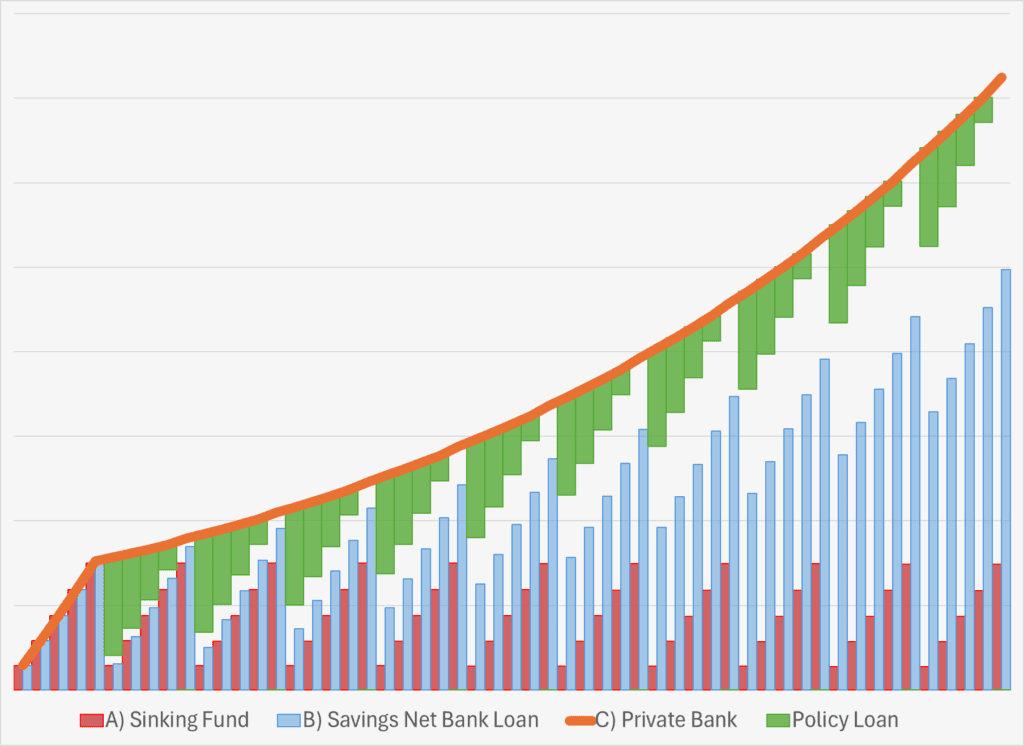
The Compounding Difference Over a Lifetime
In all three options you have spent the same amount of money during the 5 year period. After 5 years, you need another car. Due to 3% inflation, that $30,000 car now costs $34,800. With Option A, your savings are at $0 — you’ve gone backward. With Option B, you’ve roughly broken even. With Option C, you’ve come out ahead — and you keep coming out ahead every cycle, because the money you would have paid in finance charges is now building inside your own policy.
The sinking fund feels like discipline. It is actually loss. Your capital is gone, and so is all the future compounding it could have produced.
What I hope is clear is the difference between price and cost. In each case the price of the car was $30,000. Using the commercial bank, the total cost was $34,800. Using the sinking fund, that cost is much more. By practicing the Infinite Banking Concept and controlling the banking function you can recapture the interest you would have paid to the bank and keep all the future growth of your money.
Beyond Car Purchases: Applying the Banking Function Everywhere
The car purchase example is a teaching tool. The principle applies across your entire financial life:
Property taxes. Instead of withdrawing from savings, use a policy loan. Repay the loan on a schedule, and the capital that would have sat idle in a savings account keeps earning inside the policy.
Investments. Stocks, Bitcoin, real estate — finance them through your bank, not a broker’s. When markets are volatile, you are better positioned to hold because your capital base is stable.
College costs. Finance your children’s education through your policy. As they repay their “student loan” to your bank, they restore the death benefit they will ultimately receive — what Nelson Nash called “graduating” (we all have to graduate someday).
Family economy. Finance your child’s first car. Finance the down payment on their home. In time, finance the home itself. As they repay, they contribute simultaneously to your retirement income and their own inheritance.
Debt refinancing. Use policy loans to pay off high-interest consumer debt — no debt collectors, more control, faster progress.
The goal is not to take money out of the system and put it in a mattress. The goal is to turn financial headwind into tailwind — to take control of the banking function and redirect it toward your family.
Ready to Take Control?
If you’re ready to talk with someone about what this looks like for your situation, schedule a free 30-minute clarity call with William Fullington.
Semper Reformanda

See What Greater Financial Control Could Look Like
Explore how the banking function operates in your household, business, or church—and whether the Infinite Banking Concept could help you retain more control of capital and cash flow.