IBC Gimmicks: Do You Recapture Interest?
What It Actually Means
By
/ Published:
/ Updated:
/ Read Time:
In Brief:
“Recapture interest” does not mean you pay interest to yourself — that phrase is imprecise and causes real confusion. What it actually means is that interest, which would otherwise leave your personal economy permanently, stays inside it: first as a contribution to the profitability of a mutual insurance company you own, which returns surplus as a dividend, and second as payments back into your policy that increase the capital available to you.
In This Article
- Why “pay interest to yourself” is not quite right
- What you actually own when you practice IBC
- What the insurance company charges — and why
- Why mutual ownership changes the equation
- What “recapture” actually means, precisely defined
This is part of the IBC Gimmicks series — a set of articles that address common misstatements, oversimplifications, and misconceptions about the Infinite Banking Concept, whether they come from enthusiastic marketers or deliberate critics.
Why “Pay Interest to Yourself” Doesn’t Hold Up
The Infinite Banking Concept is not complicated. Accumulate wealth in an asset you have complete control over and that is guaranteed to increase in value. Then, through wise leverage, finance the things of your life — family, business, the major purchases that define a household economy. In this you retain control over the terms of every transaction and capture the opportunity cost of every dollar spent.
Simple in principle. But because the paradigm shift it requires is genuinely difficult, some teachers reach for analogies that illuminate one truth while obscuring another. The result is statements that are close enough to be persuasive but imprecise enough to mislead.
One of the most common: “You recapture interest that would have been paid to someone else’s bank.”
And the explanation that often follows: “You pay interest to yourself.”
There is something true in that second statement. But taken at face value, it is not accurate — and the inaccuracy matters.
What You Actually Own
In purchasing a life insurance policy you are not storing money, you are storing purchasing power. Your money was spent in the purchase of an asset: a dividend-paying whole life insurance contract with a guaranteed future value — the death benefit.
Because the contract has a guaranteed future value, its present value can be calculated. That present value is capital — the monetary value of property you own. The insurance company will lend you up to that present value, using the contract itself as collateral.
So when you take a policy loan, you are not borrowing your own money. You are borrowing the insurance company’s money, secured by an asset you own. This distinction is not a technicality — it is the foundation of what makes IBC work.
There Is Always a Cost of Capital
The insurance company charges interest on policy loans. This is not arbitrary. If they did not charge interest, every loan would represent a loss — the inflation drag on idle capital, plus the opportunity cost they could have earned deploying that money elsewhere. There is always a cost of capital, even when the capital is your own.
When you practice IBC, you are using the insurance company’s money. You pay them interest. That is the first fact on the table.
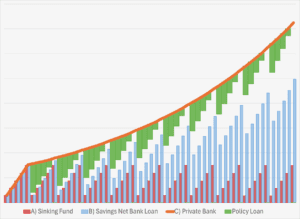
Now — if you are operating your policy as a genuine banking business, you will charge yourself at least what you would have paid to a conventional lender. If the commercial bank is charging 5%, your bank charges at least 5%. Paying yourself less is stealing from your business. The favorable repayment terms mean you will retire the loan faster than a conventional schedule would require, and the remaining payments — the ones that would have gone to the commercial bank — are instead directed back into your policy as Paid Up Additions. That portion is what people mean when they say “interest paid to yourself.”
Why Mutual Ownership Changes the Equation
There is a second part of the answer, and it depends entirely on the structure of the policy.
The Infinite Banking Concept is practiced with:
- Dividend-paying (participating) whole life insurance
- With mutually owned companies — ideally ones with an unbroken dividend history of at least 100 consecutive years
This is not a footnote. It is the mechanism.
When you take control of the banking function (storage, movement, and repayment of money) in your life, you are building a banking business. Each policy is a branch of that system. The insurance company is your partner in the enterprise — you provide the capital; they provide the legal structure, accounting, actuarial expertise, and overhead.
As your partner, the mutual company is a part of your personal economy.
When you pay interest to the insurance company, you are contributing to the profitability of a business you have an ownership stake in. Surplus profit does not disappear — it is returned to you as a dividend. When that dividend is used to purchase Paid-Up Additions, it increases the future value of your contract, which increases the present value, which increases the capital available to you for future loans.
The interest stays inside your personal economy. It does not leave.
What “Recapture” Actually Means
Here is the precise definition:
To recapture interest means that interest — which in a conventional financing arrangement would permanently leave your personal economy and grow someone else’s capital — instead remains within your economy, doing one of two things:
- Profit for a company you own. Interest the insurance company charged you for borrowing their money that increases the revenue of a company you own.
- Surplus Interest paid to ourselves instead of the commercial bank, used to purchase Paid Up Additions. Favorable loan terms mean the loan will be paid off faster, but as honest bankers we make the same payments to our bank.
One part stays because you own the company you are paying. One part stays because we are honest bankers.
That is what it means to recapture interest. Not that interest disappears. Not that you pay nothing. Not that you are lending to yourself. The interest is paid — and then it comes back.
If you are ready to take control of the banking function in your family economy, schedule a free 30-minute clarity call with an advisor today
Veritas non verbum venditoris.

See What Greater Financial Control Could Look Like
Explore how the banking function operates in your household, business, or church—and whether the Infinite Banking Concept could help you retain more control of capital and cash flow.