The Myth of Self-Insurance:
Why You Can’t Insure Your Own Life
By
/ Published:
/ Updated:
/ Read Time:
In Brief:
Self-insurance is retention, not insurance. Insurance moves a financial risk to a second party for a premium. When a man “self-insures” his life, no one else carries the risk, so his survivors and heirs bear the loss at his death. A wealthy household can absorb that loss, but absorbing a loss does not remove it.
In This Article
- What self-insurance actually is, and why a household cannot do it
- The self-insurance test and what it fails to measure
- Why absorbing a loss is still a loss
- What a man’s life is worth after age 65
- The four places an uninsured death lands
- The premium objection
- What Scripture says a father owes his household
Most households plan to outgrow their need for life insurance. The plan says that at some age, often around 65, they will hold enough assets that a death leaves the family fine: the home paid off, the children’s education provided for, and other debts cleared. Modern financial planning treats this as a goal and calls it “self-insurance.”
What Self-Insurance Actually Is
There is no such thing as self-insuring a life. Insurance is a contract in which one party agrees to indemnify another against a financial loss in exchange for a premium. The risk moves from one party to the other for a price.
Now name the parties in a self-insurance arrangement: the head of household and the household that depends on him. No second party agrees to carry the risk, no one is paid to carry it, and no one protects the household from financial loss. What planners call self-insurance is retention. The head of household keeps the risk, and his household plans to absorb the loss.
With a car, the owner who retains the risk can survive the wreck and pay for the loss himself. With a life, he cannot. The one who retains the risk of his own death is the one who dies, and a dead man cannot pay. The self that was supposed to bear the loss is gone, and his survivors and heirs bear it instead. They bear a cost they did not choose.
The Self-Insurance Test and What It Misses
Modern financial planning applies a test. If a household holds enough wealth to absorb a death (debts cleared, income that covers the survivors’ living expenses, often at a reduced lifestyle, and assets that can be sold to cover the rest), it can “self-insure,” and the advice is to drop the insurance.
The test asks only whether the survivors can live without his income. It does not ask what his death costs or whether the household will continue to thrive. A household can absorb the loss, but absorbing a loss is not being protected from it. The loss remains.
Absorbing a Loss Is Still a Loss
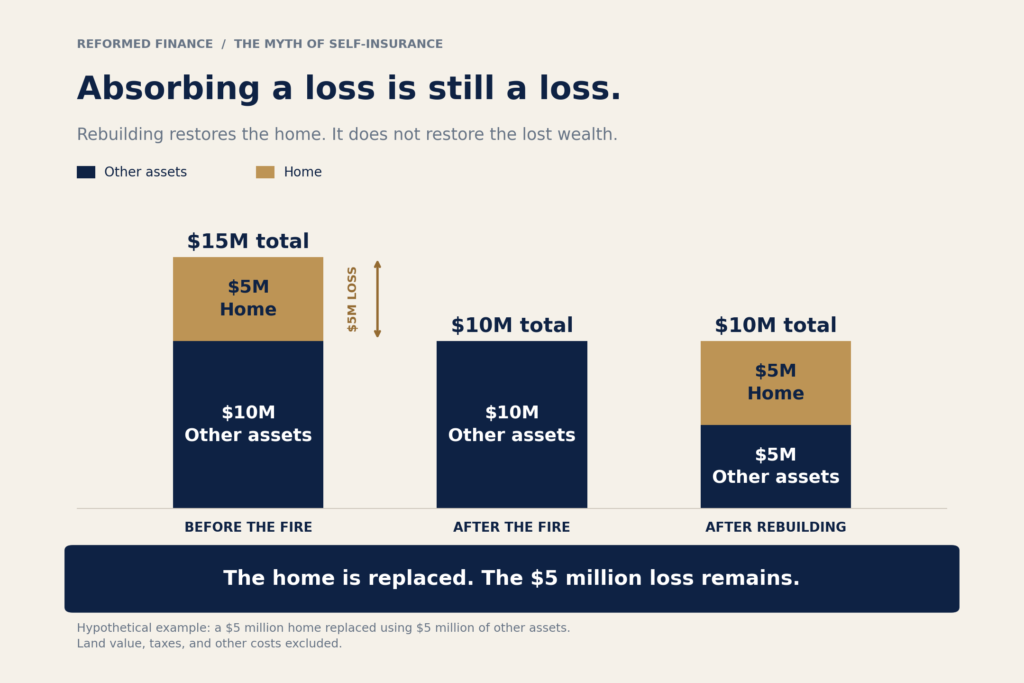
Suppose a family owns a paid-off $5 million home in the Pacific Palisades and holds another $10 million in other assets. They decide to self-insure the home because their other assets can cover it, and the house is destroyed in the January 2025 Palisades Fire (CAL FIRE, 2025).
They can absorb the loss, but rebuilding consumes $5 million of capital, and their net worth falls from $15 million to $10 million. That capital was meant for other uses: the giving, the inheritance, the growth. It would have kept compounding for the next generation, so the loss does not stop with the family that absorbs it. Their children and grandchildren inherit less. No one would tell them they had suffered no loss because they had money left over.
A death costs a family in the same way, with the loss measured in the earnings and growth that never happen. A house fire is unlikely. A death is certain, and only the date is unknown. Insurance protects against the date.
What a Life Is Worth After 65
The test rests on an assumption: at 65, or whenever the household decides it has enough, his value is zero.
That is false. A man of 65 or 75 still produces income, whether through work, a pension, Social Security, rents, or the growth of his assets. That income builds the estate, supports his family and his church, and funds the causes he gives to. Underwriters know this, and that is why you can still buy insurance after age 65. There is human life value to be insured and a real economic loss at death. Insurance economist Solomon S. Huebner developed the concept of human life value, the economic value of a person’s earning capacity, as the basis for insuring it (Huebner, 1959; Rejda & McNamara, 2017).
The plan to be “self-insured” does not remove that cost. It sends the bill to the people left behind.
Where the Loss Lands
Every purchase has a financing cost in one of two forms. Finance it and you pay interest. Pay cash and you give up the interest you would have earned. If the cash is never replaced, that cost never ends, because the capital never compounds again. The cost does not disappear. You choose its form, and replacing the cash limits its amount.
A death works the same way. Had he lived, the family would have kept a certain standard of living, left a certain inheritance, given a certain amount to the church, and seen the family economy grow by another year. His death takes something from each. None of us knows exactly how long he would have lived or how much he would have given, but the comparison is to the alternative: his living.
The loss can be moved from one place to another. It cannot be removed. Without insurance, it lands in one or more of four places, and often all four:
- The standard of living. The family lives on less. Retirement accounts, passive income, and Social Security keep paying, but at a lower level, because contributions stopped and withdrawals began early. The care he provided must be bought or done without.
- The inheritance. The heirs receive less than he planned to leave.
- The giving. The church and the causes he supported receive less than they would have.
- The growth. The year’s increase to the family’s economy never happens.
Common objections all try to move the loss from one place to another. “He can leave the church gifts in his will.” He can, and the gift then comes out of the inheritance. “His wife won’t need the house, so she can sell it.” She may, and then the home is no longer part of the inheritance. The question is also whether she sells because she wants to or because she must. A sale on her timing is a decision. A forced sale is a cost.
The insured household faces none of these forced choices. A death benefit sized to the loss pays the difference, so the family lives as planned, the inheritance is left, the church is supported, and the estate keeps growing. The loss is covered, and the family decides what to change, if anything.
The Premium Objection
The strongest objection is the premium, and it deserves a straight answer. The self-insured household does save it. But the premium is the price of transferring the risk. Saving that price does not eliminate the cost of the loss. It leaves that cost with the people he leaves behind. The premium is a limited cost. A loss absorbed from capital is cash that is never replaced, so its cost never ends.
What a Father Owes
Scripture says, “A good man leaves an inheritance to his children’s children” (Proverbs 13:22). The child is not entitled to it, and there is no legal claim a court will enforce. But a father owes an inheritance to a son raised and trained to steward it. He may withhold it from a prodigal and should make allowances for restoration.
Insurance lets him keep that duty no matter when he dies. The death benefit sets a minimum legacy and frees the insured to spend, give, and build with the rest. The self-insured plan is to accumulate and then spend down, and the legacy is whatever is left. There is no floor under it.
Scripture also commands us to love our neighbor as ourselves (Matthew 22:39), and a man’s nearest neighbors are his household. They will help carry a loss, as love requires, but his duty is to prepare so they do not have to carry it alone. Self-insurance, like being uninsured, counts on their love to cover the difference. Paul sets the standard for provision high: a man who does not provide for his household “has denied the faith and is worse than an unbeliever” (1 Timothy 5:8, ESV).
The Steward’s Choice
If you had a machine in your garage that printed a steady stream of money to provide for your family at the standard of living you have now, fund your giving, and leave the legacy you want for your children, would you insure it against loss? Or would you make them bear the cost if it is destroyed?
“Self-insurance” sounds responsible, but it is a myth. It saves the premium, yet the risk is still retained, and the man who “self-insures” is not the one who bears it. Those he leaves behind do. A faithful steward does not leave his obligations for his heirs to pay. He counts the cost ahead of time and pays it while he is able.
If you are weighing whether your plan leaves your household protected or only able to absorb a loss, Schedule a 30-minute clarity call.
Semper Reformanda.
References
CAL FIRE. (2025). Palisades Fire [Incident report]. California Department of Forestry and Fire Protection. https://www.fire.ca.gov/incidents/2025/1/7/palisades-fire
Huebner, S. S. (1959). The economics of life insurance (3rd ed.). Appleton-Century-Crofts.
Rejda, G. E., & McNamara, M. J. (2017). Principles of risk management and insurance (13th ed.). Pearson.
Scripture quotations are from the ESV® Bible (The Holy Bible, English Standard Version®), copyright © 2001 by Crossway.

See What Greater Financial Control Could Look Like
Explore how the banking function operates in your household, business, or church—and whether the Infinite Banking Concept could help you retain more control of capital and cash flow.