Lies and Rates of Return:
Why Rate of Return Is Not an Interest Rate
By
/ Published:
/ Updated:
/ Read Time:
In Brief:
Rate of return and interest rate are not the same thing — and conflating them is one of the most common (and costly) errors in conventional financial advice. Rate of return is a backward-looking measurement of what happened; interest rate is used to calculate what will happen. Applying an average rate of return as if it were a guaranteed interest rate leads to wildly incorrect projections of future wealth.
In This Article
- What rate of return actually means — and what it doesn’t
- How interest rate differs from rate of return
- Why the Rule of 72 breaks down in volatile markets
- The math behind average vs. compound rates of return
- Why volume of return matters more than rate of return
- What this means for your financial planning
Two Numbers That Are Not the Same Thing
Financial professionals and popular financial entertainers routinely use “rate of return” and “interest rate” as if they were interchangeable. They are not — and the difference matters enormously when you are projecting future wealth.
Rate of Return (ROR) is the percentage change in the value of an investment over a specific period, expressed as a percentage of its initial cost:
ROR (%) = ((Final Value – Initial Cost) / Initial Cost) × 100
Interest rate, on the other hand, is the amount of interest due (or paid) per period, expressed as a proportion of the principal sum borrowed (or the present value of an interest-bearing account):
Future Value = Present Value × (1 + Interest Rate) ^ Number of Compounding Periods
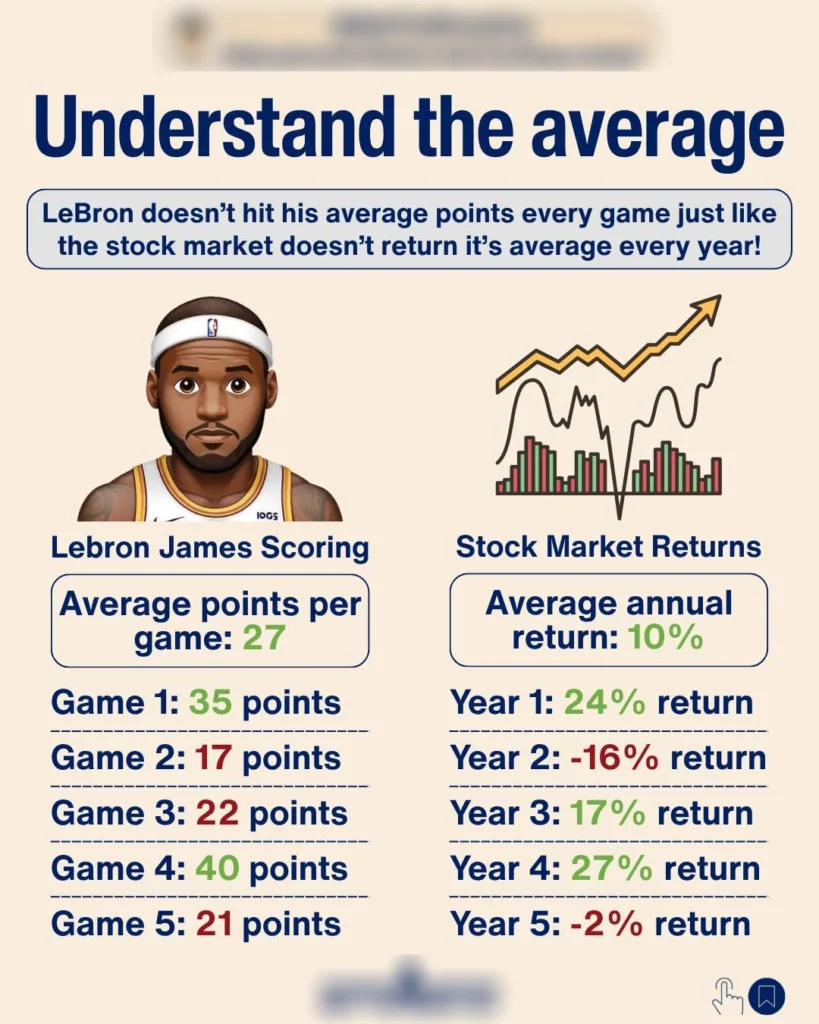
1) Lebron can’t score negative points
2) Points per game don’t compound
With algebra, you can solve for the interest rate itself:
Interest Rate = ((Future Value / Present Value) ^ (1 / Number of Periods)) – 1
This is also the formula for Compound Annual Growth Rate (CAGR), sometimes called the compound rate of return.
Example: $100 grows to $106.09 over 2 years. ((106.09 / 100.00) ^ (1/2)) – 1 = 3% interest rate / CAGR
The Critical Difference: Time
Interest rate is always calculated for a given number of periods. Without knowing the number of periods, you cannot calculate a meaningful interest rate — and annual is assumed when no period is stated.
Rate of return, by contrast, covers only a single period — and without knowing the length of that period, the number is nearly meaningless.
A 20% rate of return sounds excellent. Invest $100, get $120 back. (120 – 100) / 100 × 100 = 20%
But what if that took 20 years to earn that extra $20? ((120 / 100) ^ (1/20)) – 1 = 0.916% interest rate / CAGR
That is a dramatic difference — and it will have a significant impact on long-term financial planning.
Why the Rule of 72 Breaks Down
The Rule of 72 is way of estimating how long it takes to double your money at a given interest rate. Simply divide 72 by the interest rate to get an approximate time. For example, at 12%, the rule says you should double your money in 6 years.
| Year | BOY Value | EOY Value | Annual ROR | CAGR |
| 1 | $ 100.00 | $ 112.00 | 12% | 12% |
| 2 | $ 112.00 | $ 125.44 | 12% | 12% |
| 3 | $ 125.44 | $ 140.49 | 12% | 12% |
| 4 | $ 140.49 | $ 157.35 | 12% | 12% |
| 5 | $ 157.35 | $ 176.23 | 12% | 12% |
| 6 | $ 176.23 | $ 197.38 | 12% | 12% |
The Rule of 72 is not actually a rule — it is a mathematical shortcut. It works reasonably well for nonvolatile, predictable returns. It is dubious at best when applied to volatile markets.
The Volatility Problem: Same Average, Very Different Outcomes
Consider two hypothetical portfolios — each running 6 years, 5 positive one negative. And each with an average annual ROR of 12%, but with very different ending values.
| Year | BOY Value | EOY Value | Annual ROR | CAGR |
| 1 | $ 100.00 | $ 120.00 | 20% | 20% |
| 2 | $ 120.00 | $ 134.40 | 12% | 15.93% |
| 3 | $ 134.40 | $ 161.28 | 20% | 17.27% |
| 4 | $ 161.28 | $ 112.90 | -30% | 3.08% |
| 5 | $ 112.90 | $ 146.76 | 30% | 7.97% |
| 6 | $ 146.76 | $ 176.12 | 20% | 9.89% |
| Year | BOY Value | EOY Value | Annual ROR | CAGR |
| 1 | $ 100.00 | $ 124.00 | 24% | 24% |
| 2 | $ 124.00 | $ 153.76 | 24% | 24% |
| 3 | $ 153.76 | $ 190.66 | 24% | 24% |
| 4 | $ 190.66 | $ 238.33 | 25% | 24.25% |
| 5 | $ 238.33 | $ 297.91 | 25% | 24.4% |
| 6 | $ 297.91 | $ 148.96 | -50% | 6.87% |
The first ends with $176.12 — a compound annual growth rate of 9.89%. Due to the losses in year 4, you would need an additional year at 12% return to have doubled your money.
The second ends with $148.96 — a compound annual growth rate of 6.87%, despite an average annual ROR of 12%. That would require nearly 3 additional years at 12% to recover and double the original investment.
The Fallacy of Equivocation in Financial Advice
Some popular financial entertainers instruct callers to “find a mutual fund that provides a 10% rate of return” and then calculate future value by plugging that number into an interest rate calculator. This commits two related errors:
- The gambler’s fallacy — assuming past performance predicts future results, despite every prospectus stating otherwise.
- The fallacy of equivocation — using “rate of return” and “interest rate” as if they mean the same thing.
Ask yourself: if you could get a savings account with a guaranteed 10% interest rate, would you put any money in the stock market?
Rate of return and interest rate are not interchangeable. Conflating them produces dangerously optimistic projections.
Volume of Return Matters More Than Rate of Return
To make this concrete, consider a five-year sequence:
- Year 1: +100% → $100 becomes $200
- Year 2: -50% → $200 becomes $100 (average ROR so far: 25%; compound: 0%)
- Year 3: +50% → $100 becomes $150 (average: 33.3%; compound: 14.5%)
- Year 4: -25% → $150 becomes $112.50 (average: 19%; compound: 2.99%)
- Year 5: -25% → $112.50 becomes $84.38 (average: 10%; compound: -3.34%)
After five years with an average annual rate of return of 10% — the exact figure frequently cited in conventional financial advice — you have less money than you started with. The compound rate of return is -3.34%.
This is why Will Rogers quipped: “I am not so much concerned with the return on capital as I am with the return of capital.”
You can lose a great deal of money behind numbers showing consistently positive average annual return. There are lies, damned lies, and statistics. Rate of return is a statistical measurement — useful for analyzing past performance. Applying it to predict future values in volatile markets is not valid. It is only valid for prediction in assets with guarantees.
What This Means for Controlling Your Banking Function
The distinction between rate of return and interest rate is not academic. It determines whether your long-term projections are grounded in reality or in optimistic fiction.
Conventional finance ignores the banking function (storage, movement, and repayment) entirely — and then compounds that error by modeling future wealth using average rates of return as if they were guaranteed interest rates. As the math in this article demonstrates, those two numbers are not the same.
But there is a deeper point. Even if the rate projections were honest, rate is the wrong thing to optimize. Volume of return matters more than rate of return. Five percent of $100,000 is more than ten percent of $10,000. Controlling the banking function — keeping capital moving, accessible, and working — is how volume is built. Controlling the banking function is the most significant financial decision a family can make, and it is the one conventional advice never addresses.
If you’re ready to take control of the banking function, or just want to learn more, schedule a free 30-minute clarity call with an advisor today.
Semper Reformanda.

See What Greater Financial Control Could Look Like
Explore how the banking function operates in your household, business, or church—and whether the Infinite Banking Concept could help you retain more control of capital and cash flow.