
IBC Policy Design: Form Follows Function
By
/ Published:
/ Updated:
/ Read Time:
In Brief:
An IBC whole life policy is designed around one principle: form follows function. The function is systematic capital accumulation, which means maximizing the premium you can put into the policy for as long as possible without triggering Modified Endowment Contract (MEC) status. The ratio of Base to Paid-Up Additions (PUA) premium, combined with dividends and any term rider, determines how well a given policy fulfills that function.
In This Article
- What policy design means for IBC
- Base and PUA: the premium ratio explained
- Dividends and the MEC line
- The 7-Pay Test and MEC risk
- Why high-base designs matter long-term
- The role of the term rider
- There is no one-size-fits-all design
What Policy Design Means for IBC
The Infinite Banking Concept is a process, not a product. Even so, the ideal vehicle for practicing Becoming Your Own Banker is a specific financial product: a participating whole life insurance policy from a mutual company. Like any product, form follows function.
The function of an IBC policy is the systematic accumulation of capital to provide for your need for the banking function (storage, movement, and repayment). This defines the basic parameters for policy design. The specific needs of the owner — age, health, income, goals, timeline — determine the specifics.
Before going further, two of Nelson Nash’s foundational rules must stay front of mind throughout this discussion: Don’t Be Afraid to Capitalize and Think Long Range.
Base and PUA: The Premium Ratio Explained
When practitioners speak of policy design, they are speaking of the ratio of Base to PUA (Paid-Up Additions) premium paid — expressed as a fraction such as 10/90 or 40/60. There is no universal standard for which number comes first. Throughout this article, the first number refers to the proportion of Base premium and the second refers to PUA.
The Base percentage is the defining number: it represents what portion of total premium paid goes to the base whole life policy. PUA is simply 100% minus the base percentage.
Many policies also include a term rider, whose cost is not expressed in this ratio format. A “40/60” policy means 40% of total premium is Base — whether the remaining 60% is split 5% term / 55% PUA or 1% term / 59% PUA. The ratio describes the first policy year. Over time, as dividends purchase additional PUA, the base percentage will gradually decline — a 40/60 policy becomes closer to 38/62 by year 10 — but it is still referred to by the original design ratio.
Dividends and the MEC Line
Hardly a word can be spoken about IBC without discussion of dividends. Dividends are classified by the IRS as a return of premium, but they are also the policyholder’s share of the mutual company’s profitability. In IBC, the first-choice application of dividends is to purchase more Paid-Up Additions.
Each policy has a limit on how much out-of-pocket PUA the owner can purchase per year. There is no corresponding limit on PUA purchased using dividends — the company is paying additional premium into your policy on your behalf, with no ceiling.
Total annual premium = Base + Term + PUA + Dividend
% Base = Base ÷ Total Premium
As dividends grow over time, the base percentage of total premium decreases. This is not a problem — it is the policy working as designed. But it has a critical implication: dividends pull the policy toward the Modified Endowment Contract (MEC) line. Understanding this is the key to sound policy design.
The 7-Pay Test and MEC Risk
The IRS designates a life insurance policy as a Modified Endowment Contract (MEC) when it determines the policy is functioning as an investment rather than insurance. This determination is made using the 7-Pay Test: a policy becomes a MEC if total premiums paid in any 7-year period exceed the premium that would fully pay up the same death benefit in 7 equal annual payments.
MEC status is permanent — once a policy is classified as a MEC, it cannot be reclassified. MEC status removes key tax advantages: policy loans are treated on a Last-In-First-Out basis, meaning loans are drawn first from gains, which are taxed as ordinary income at the owner’s top marginal rate.
A few MEC rules worth knowing:
MEC determination is recalculated every time a substantive change to the policy occurs — including purchasing PUA, a term rider dropping off, or renewing a one-year term.
Ordinary whole life at 100% Base can only become a MEC through owner action.
Single Premium Whole Life is automatically a MEC.
Any policy placed into Reduced Paid-Up (RPU) status before 7 years is also a MEC by definition.
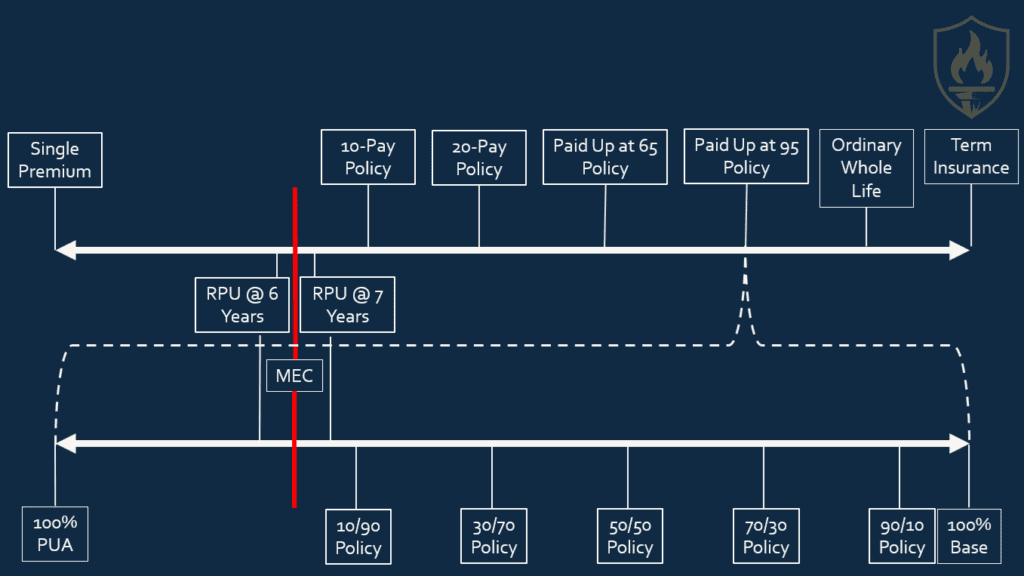
Every illustration states whether a policy “is or is not a modified endowment contract as illustrated.” Key words: as illustrated. An illustration is a snapshot — inaccurate the moment it is printed. Future dividends are not guaranteed; future owner behavior is unknown. What is known is that increasing dividends and any reduction in death benefit growth move a policy closer to the MEC line.
The tables below show how the annual base percentage shifts over time for a 40/60 and a 10/90 design, as dividends compound:
40/60 Policy Design — Base % Over Time
| Policy Year | Base 40% | Term 2% | PUA 58% | Dividend | Annual Base % | 7 year Base % |
|---|---|---|---|---|---|---|
| 1 | $100 | $5 | $145 | $2 | 39.68% | |
| 2 | $100 | $5 | $145 | $4 | 39.37% | |
| 3 | $100 | $5 | $145 | $6 | 39.06% | |
| 4 | $100 | $5 | $145 | $8 | 38.76% | |
| 5 | $100 | $5 | $145 | $10 | 38.46% | |
| 6 | $100 | $5 | $145 | $12 | 38.17% | |
| 7 | $100 | $5 | $145 | $14 | 37.88% | 38.76% |
| 8 | $100 | $5 | $145 | $16 | 37.59% | 38.46% |
| 9 | $100 | $5 | $145 | $18 | 37.31% | 38.17% |
| 10 | $100 | $5 | $145 | $20 | 37.04% | 37.88% |
| … | … | … | … | … | … | … |
| 55 | $100 | – | $145 | $110 | 28.17% | 28.65% |
10/90 Policy Design — Base % Over Time
| Policy Year | Base 10% | Term 2% | PUA 88% | Dividend | Annual Base % | 7-year Base % |
|---|---|---|---|---|---|---|
| 1 | $25 | $5 | $220 | $2 | 9.92% | |
| 2 | $25 | $5 | $220 | $4 | 9.84% | |
| 3 | $25 | $5 | $220 | $6 | 9.77% | |
| 4 | $25 | $5 | $220 | $8 | 9.69% | |
| 5 | $25 | $5 | $220 | $10 | 9.62% | |
| 6 | $25 | $5 | $220 | $12 | 9.54% | |
| 7 | $25 | $5 | $220 | $14 | 9.47% | 9.69% |
| 8 | $25 | $5 | $220 | $16 | 9.40% | 9.62% |
| 9 | $25 | $5 | $220 | $18 | 9.33% | 9.54% |
| 10 | $25 | $5 | $220 | $20 | 9.26% | 9.47% |
| … | … | … | … | … | … | … |
| 55 | $25 | – | $220 | $110 | 7.04% | 7.16% |
A 10/90 design starts with a base percentage already close to the MEC line — and moves closer every year dividends are paid. There is very little margin for error. A 40/60 design starts farther from the MEC line and maintains meaningful buffer and the owner will be able to pay max PUA throughout the life of the policy.
Why Higher-Base Designs Matter Long-Term
Some agents advocate for 10/90 or other skinny-base designs because they produce higher early cash value. This focus on early liquidity violates both of Nash’s rules: Don’t Be Afraid to Capitalize and Think Long Range.
That higher early cash value comes at two costs:
1. Greater MEC risk over time. As shown in the tables above, a 10/90 design leaves almost no buffer from the MEC line from year one. With decades of compounding dividends ahead — especially for younger insureds — the risk of inadvertently crossing the MEC line is substantially higher.
The way to avoid crossing the MEC line is to reduce premium. But that is not something we want. If your policy is generating multiple times more than you pay in premium, do you want to pay more in premium, or less?
2. Reduced long-term dividends. Dividends are not credited at a flat rate across all policy components. Generally, dividends are paid at a higher rate on the Base portion of the policy than on PUA. This is because PUA premium is immediately liquid — available for policy loans — and does not contribute to the generation of divisible surplus. A higher Base percentage means more of your total premium is generating dividends at the higher rate.
As an illustration from practice: a 40/60 policy’s annual statement showed that 78% of the dividend came from the 40% Base premium, and only 22% from the 60% PUA. More base means more dividend — for the entire life of the policy. And dividends buy more death benefit. And dividends are paid on dividends.
The practical liquidity question:
Consider a policyholder who has $100,000 to move into a policy over 10 years at $10,000/year. A 50/50 design might show $5,000 in available cash value in year one; a 10/90 might show $8,000. But $90,000 remains outside the policy — still accessible. A total of $95k liquid with a 50/50 or $98k with a 10/90. The real question is: do you really need access to that $3,000 right now, while still being able to fund next year’s premium? Or is avoiding the start-up cost simply a fear of capitalizing?
There are no shortcuts. The start-up cost can be paid now — in the form of modest short-term illiquidity — or paid later, in the form of lower lifetime dividends and a narrower MEC buffer. The math favors paying it early.
The Role of the Term Rider
A term rider may be included in an IBC policy for two reasons:
1. Expand the death benefit gap. The 7-Pay Test compares premiums paid to the death benefit of the policy. A term rider increases the total death benefit, widening the gap between cash value and death benefit and creating room to purchase more PUA without triggering MEC status.
2. Create controlled drag. A small term rider creates a modest drag on cash value growth, preventing cash value from increasing too quickly relative to the death benefit.
The term rider is a sunk cost — like any term insurance. It counts toward total premium paid in the 7-Pay Test but does not contribute to cash value. The amount of death benefit on the term rider is selected to find a sweet spot: allowing the owner to maximize capitalization for as long as possible while maintaining MEC buffer.
When the term rider eventually drops off, that is a substantive change requiring MEC recalculation. A well-designed policy accounts for this from the beginning.
There Is No One-Size-Fits-All Design
Every policyholder’s situation is different. Age, health rating, income, family economy goals, and time horizon all affect the appropriate design. There is no universal right answer.
In one sentence, the Reformed Finance philosophy for IBC policy design is this: To allow the policy owner to put as much capital into their policy for as long as possible.
That principle — not the pursuit of early liquidity — is what drives every recommendation.
Remember to Think long range and Don’t be afraid to capitalize.
If you’re ready to take control of the banking function (storage, movement, and repayment) in your family economy, schedule a free 30-minute clarity call with William today.
Semper Reformanda.

See What Greater Financial Control Could Look Like
Explore how the banking function operates in your household, business, or church—and whether the Infinite Banking Concept could help you retain more control of capital and cash flow.