
The Banking Function
In Brief:
The banking function is the storage, movement, and repayment of capital. Many households store money and move it out to meet needs, then move on, so each purchase shrinks the capital the family has to work with. Saving again later is not repayment: repayment is a deliberate plan to replace what was used, so the next need meets a rebuilt capital base instead of whatever happened to accumulate.
More Than A Building
What is the Banking Function?
We usually use the word bank to describe an institution. But banking is also a function. It takes place whenever capital is gathered, held until needed, made available for use, and restored so it can be used again.
Every household is responsible for this function. Income arrives. A portion is stored. Money is then used for vehicles, repairs, education, business opportunities, emergencies, and countless other needs.
For most households, the process ends there. Money is accumulated and then spent. The capital is gone, and the next need must be met by saving again or borrowing from someone else. When a household borrows from someone else, the lender sets the terms. Controlling the banking function means the household sets its own.
A functioning bank does not merely store and distribute capital. It must also restore its capacity to serve the next need.
The Blood Bank Analogy
The Third Step Keeps the System Alive
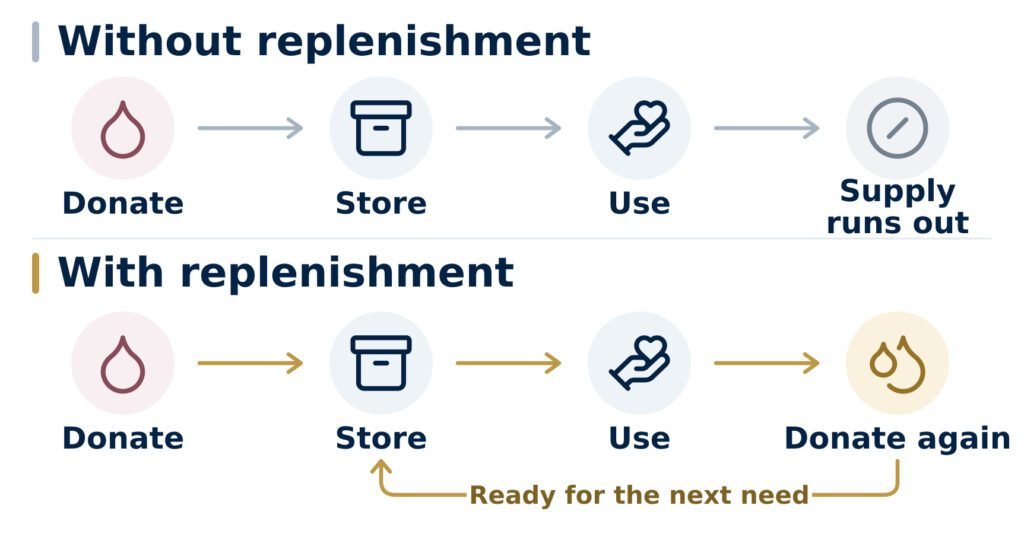
A blood bank performs a simple but vital function. It receives blood from donors, stores it safely, and makes it available when patients need it.
But imagine a blood bank that only collected blood once and then distributed it until the shelves were empty. It might meet today’s needs, but it would soon lose the ability to serve anyone else.
For the system to continue, its supply must be replenished. New donations must replace what was distributed.
01
Collect and Store
Blood enters the system and is kept safely until it is needed.
02
Distribute and Use
Blood is deployed to meet a real and immediate need.
03
Replenish the Supply
New donations restore capacity so the system can serve again.
Skip the third step and in time the blood bank will become empty and of no use. The same is true of a household’s capital.
The Household Pattern
Most Families Stop After the Second Step
Households also collect, store, and distribute something valuable. They earn income, accumulate savings, and use that money to meet needs or pursue opportunities.
Yet after the money is used, very little thought is given to replenishing the supply. The family may eventually save more, but there is usually no deliberate repayment connected to the purchase that reduced its capital.
The Common Pattern

Accumulate
Save money for a future need

Spend
Use the accumulated money
Stop
Capital base is consumed
Household Economy
Capitalize
Build a supply before it is needed

Deploy
Use capital for a need or opportunity
Repay
Restore the capital that was used
Reuse
Put the restored capacity to work again
Cash or Capital?
The Difference is How You Treat Your Money
Cash is commonly viewed as something waiting to be spent. Once the purchase is complete, its job is finished.
Capital is money held to meet needs as they arise. It can be used, but its use carries a responsibility to replace what was used.
The dollars may look identical in an account. Their role is different because the owner relates to them differently.
The Missing Step
Repayment Is What Completes the Function
A Simple Example
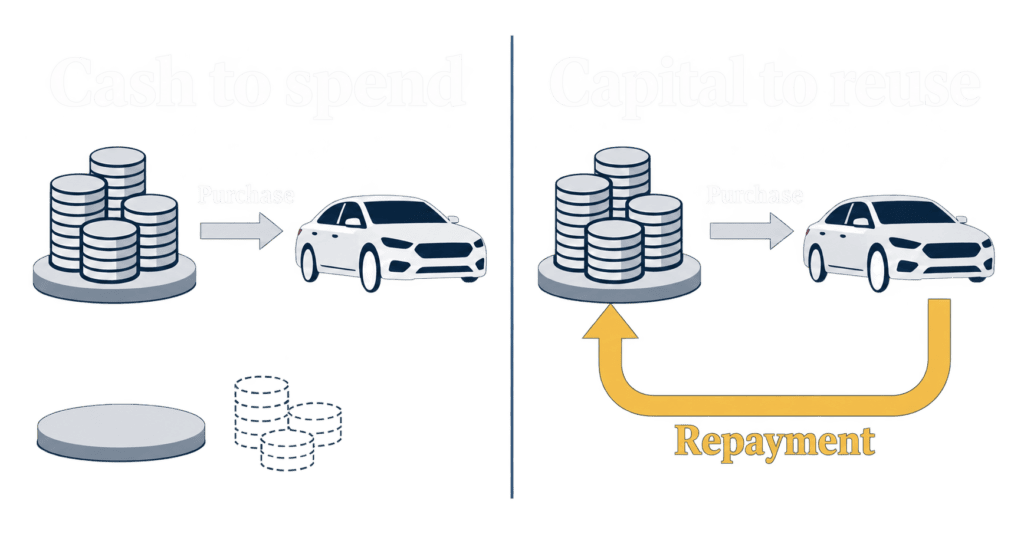
A family accumulates $30,000.
It uses $25,000 to purchase a vehicle.
The family now has only $5,000 available.
Without repayment, the next major need meets a $5,000 base.
With repayment, the vehicle purchase becomes part of a continuing capital cycle.
We readily accept repayment when we use someone else’s money. A car lender expects monthly payments. A mortgage lender expects principal and interest. The obligation is clear because the lender will enforce it.
When we use our own capital, no one enforces anything. We call the purchase “paid for” and move on, but it has still reduced the capital available for the next need. Saving again afterward is not the same as repayment. It is unplanned, unconnected to the purchase, and depends on what is left over.
Repaying your own system means establishing a deliberate plan to restore what was used. That repayment rebuilds capacity. It turns a one-time pool of cash into a capital base capable of serving the family repeatedly.
Repayment is not a penalty for using capital. It is what keeps capital available for the next need.
The Banking Function
Storage, Use, Repayment—and Reuse
Controlling the banking function begins with recognizing the entire cycle. Accumulating money is only the beginning. Accessing it is not the end.
Store Capital
Build a supply base before the need arises.
Access and deploy it
Put capital to work, meeting needs and opportunities.
Repay what was used
Restore the capacity consumed by the purchase.
Repeat the process
Allow a rebuilt capital base to serve many needs over time.
The Next Question
Where Should This Capital Be Stored?
Once the full banking function is understood, the next question is where capital can reside while remaining safe, liquid, accessible, and capable of long-term growth. Different assets perform different jobs, and not every place we store wealth is suited to support the banking function.
Build a Capital Base That Can Serve Repeatedly
The Infinite Banking Concept® is the process of controlling the banking function: the storage, movement, and repayment of capital.